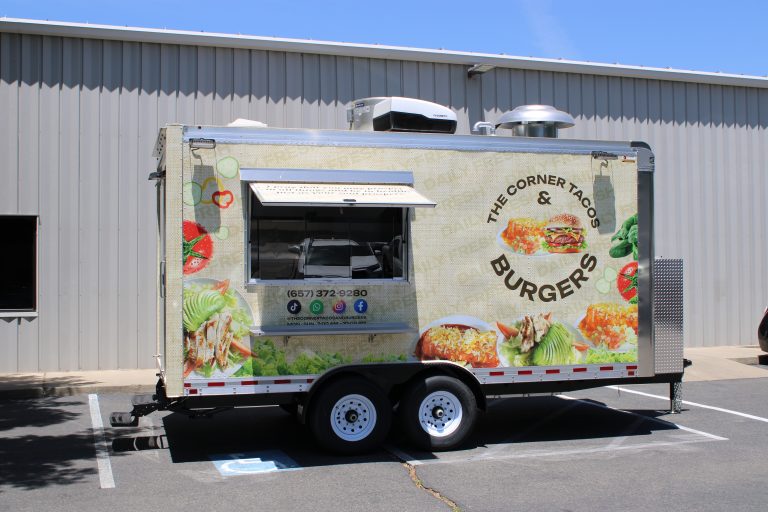
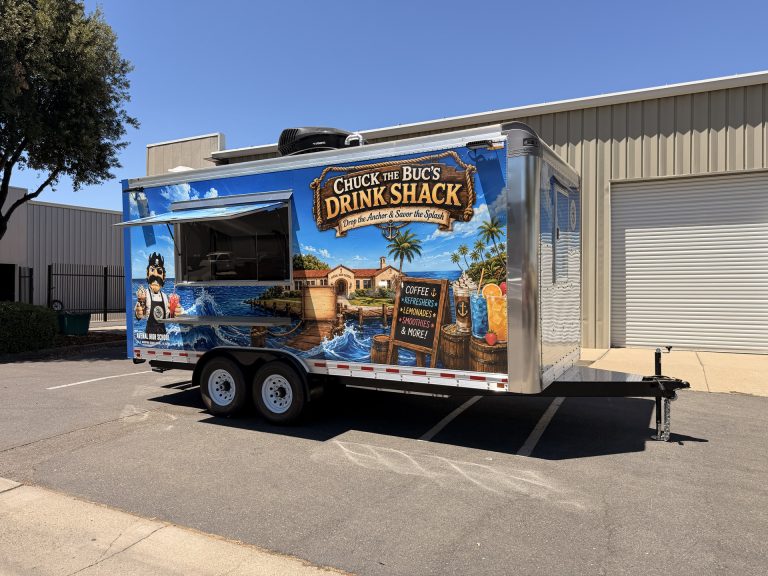
Every trailer is fabricated by our own team in Olivehurst, CA. You can visit by appointment and see yours at any stage. When production is complete, pick it up at the shop or have it delivered to Houston. We deliver to all 50 states.
In Houston, the next stop is the inspection. The city's Health Department inspects the unit for DSHS (Texas Department of State Health Services), the state licensing agency. If the unit cooks on propane, it also visits the Fire Marshal's Environmental Inspection Center for its L1 permit.







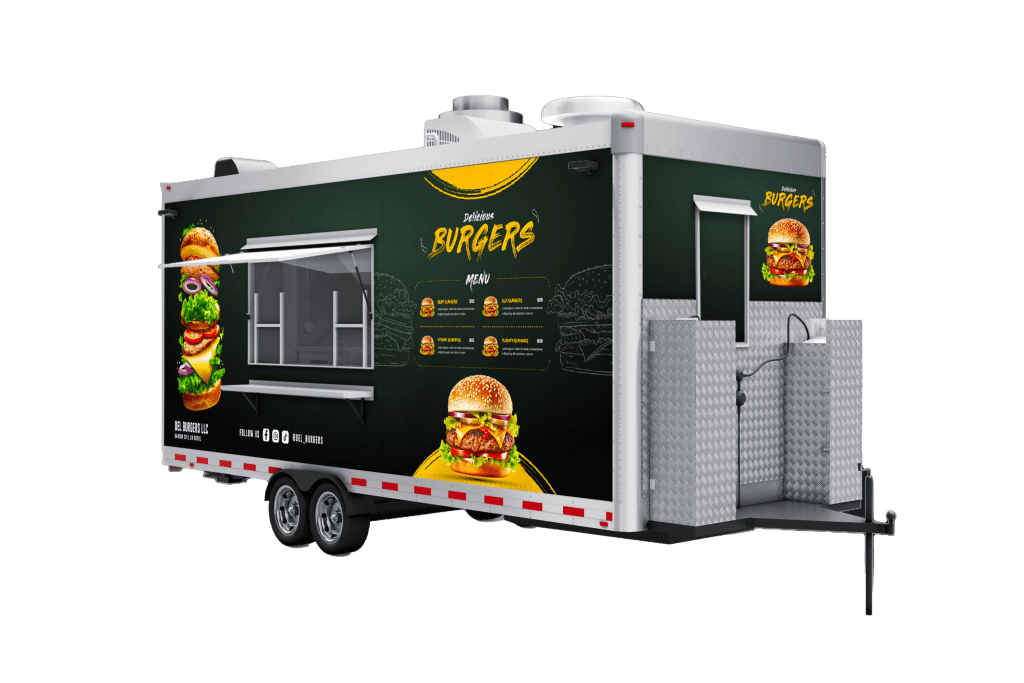


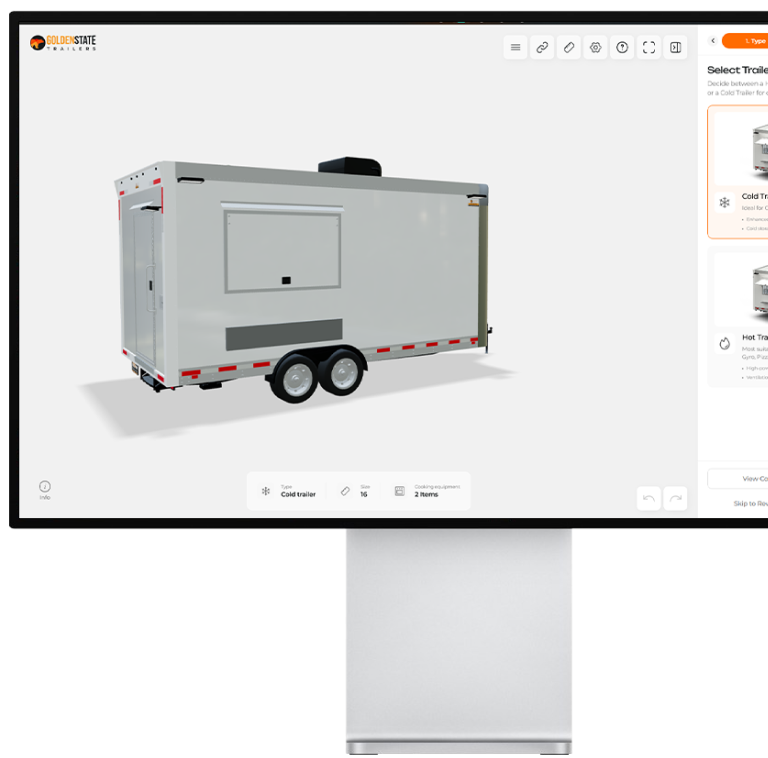
Our 3D builder is free and needs no registration. Pick hot or cold and a size, then add kitchen equipment, service-side items and extras such as an awning. The awning shelters your line from sun and rain. The builder keeps your design for 90 days, ready to edit or share.
Design for the state's pre-licensing inspection: sinks, refrigeration and wastewater must work with no power or water hookup. The builder lists generators among its additional options, so settle that power source before you submit the build.
Golden State Trailers builds custom food trailers for sale in Houston, all made in-house in Olivehurst, California. We plan each layout from the menu outward, then deliver the finished trailer to your Houston site.
A barbecue trailer cooking through a Houston summer and a coffee trailer need different kitchens. We build both, from a single unit to multi-unit projects for franchises, schools and corporate food service.
For layout ideas, browse our food trailers for sale and our custom food trailers. Compare lengths from 16 to 30 feet in our food trailer design and sizes overview.
With the lot owner’s permission, a licensed concession trailer can serve from a private lot in Houston. The Houston Health Department’s page lists a property letter among its inspection documents. It also lists a restroom letter from a business within 500 meters.
The department’s mobile food unit page also lists a form naming the locations where you plan to operate. Confirm the current forms with the department before you commit to a site.
Every food trailer that serves customers in Texas needs its own state license, held by its operator. In Houston, as across the state, that license comes from DSHS, the Texas Department of State Health Services.
For Houston units, the city’s Health Department performs the pre-licensing inspection for the state. That inspection comes before a new unit’s first service, and the license then runs one year from it.
The inspection asks for printed copies of your unit’s plans. Each trailer ships with engineering blueprints of its electrical and plumbing systems, plus the gas system on hot builds. Confirm current state requirements on the DSHS mobile food vendor page before you order.
Plan the trailer’s base early. The unit works from a commissary unless DSHS exempts it at inspection, and a private home cannot serve as one. Ask DSHS how early you can apply, so the paperwork moves while the trailer is in production.
The Houston Health Department lists what its inspectors check. Settle these items while you review the 3D render:
The menu sets the equipment, and the equipment sets the fuel and the fire rules. Fire inspections stay local, and the Houston Fire Marshal covers units inside city limits. Cooking on propane takes the Fire Marshal’s annual L1 permit and an inspection at the Environmental Inspection Center.
Units without propane, running on electricity, firewood or charcoal, need no fire permit. The Fire Marshal’s minimum requirements still apply to every unit. Cooking that produces grease-laden vapors needs a Type 1 ventilation system and a kitchen fire suppression system.
The Fire Marshal’s mobile food unit permit guide exempts some listed electric appliances from that rule. It also requires an ABC extinguisher rated 3A:40BC on every unit, plus a Type K rated 2A:K for deep-frying. The guide sets clearances of 10 feet from buildings and 25 feet from other propane units.
Each hot trailer we build has ventilation, fire suppression and gas lines, while a cold, non-cooking trailer skips them. Our build standards list a UL 710 compliant hood built to NFPA 96 and a 14×14 make-up air system. The 400,000 BTU propane system has automatic changeover and a shut-off valve for each appliance.
Houston’s average high in early August is 96°F, and a hot line adds its own heat inside the trailer. Our builds include a roof-mounted 15,000 BTU air conditioner and enhanced insulation with reinforced interior backing.
Houston also averages more than 50 inches of rain a year. The one-piece aluminum roof is crowned for runoff, and the riveted aluminum exterior is built to resist water intrusion.
Fabrication starts after you approve the 3D render of your layout, as our build process shows step by step. If DSHS asks for plan review, we prepare the plan sets and support you through it. Before it ships, we test the brakes, structure, hood airflow and fire suppression, plus gas pressure, plumbing and electrical load.
At handoff, our team shows you how to run the cooking equipment, gas, electrical, water tanks and fire suppression. We deliver to Houston and anywhere else in the 50 states.
Price follows size, equipment and layout. After your consultation, you receive an itemized estimate of the scope, equipment and build specifications.
We cover financing in the same consultation, and a bank or finance company you choose can fund the build. Request a quote and describe your menu, trailer size and timeline in the form.

At Golden State Trailers, we build custom commercial food trailers around real operational needs. Every project is planned with equipment, workflow, systems, safety, and long-term reliability in mind. Our goal is to build food trailers that perform reliably in daily commercial use.