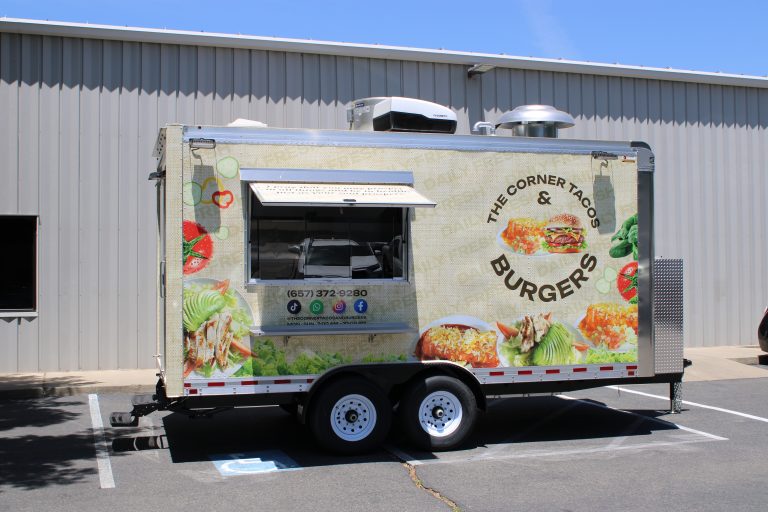
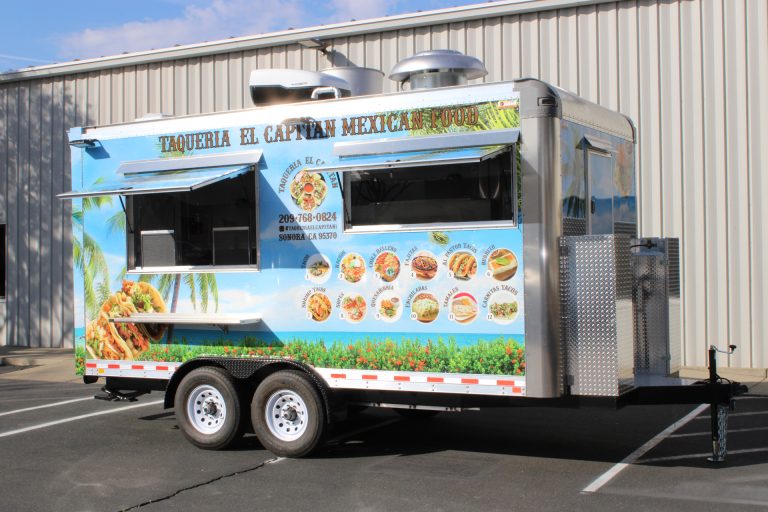
Our team fabricates and fits out your trailer in Olivehurst, CA. Visits are by appointment, and you may watch it at any stage of production. When the build is done, pick it up from us or have it shipped to Dallas. Delivery covers all 50 states.
In Dallas, settle the trailer's base early. DSHS rules tie it to a commissary or another fixed food establishment unless it qualifies for the commissary exemption. Its servicing area cannot be at a private home.





Using the 3D builder costs nothing, needs no account and sets no cap on attempts. Pick hot or cold and a length. Cooking equipment goes on the kitchen side and service items on the customer side, which already has the required sinks. Saved designs stay open for 90 days.
In Dallas, design for the DSHS pre-licensing inspection, where the trailer has to run without electrical or water connections. Settle the power source for refrigeration and hot water early; the builder lists generators under its additional options.
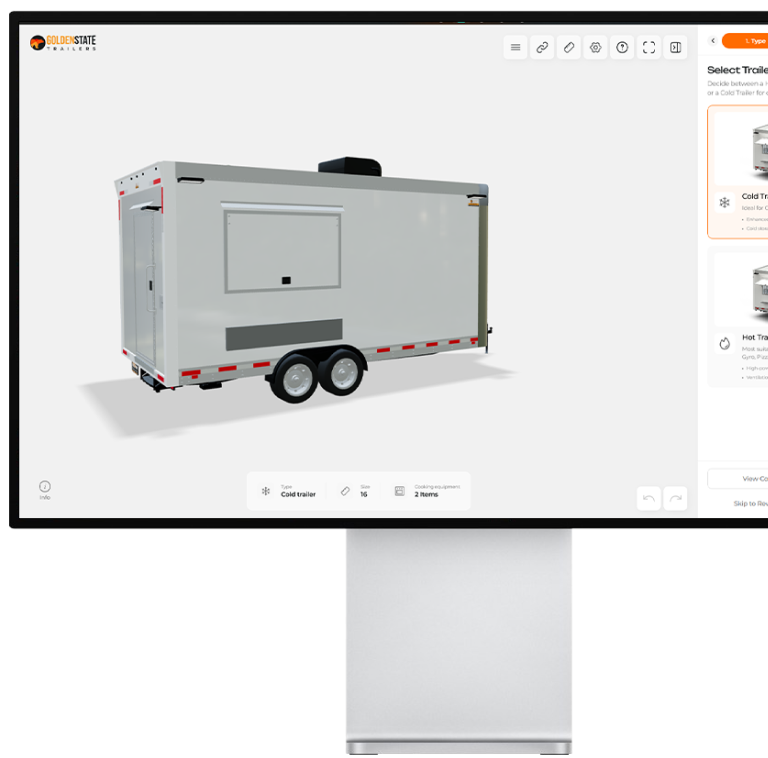
Our food trailers for sale in Dallas are custom commercial kitchens, fabricated in-house at our California shop. We engineer the kitchen around the menu and the crew inside, then deliver it to Dallas. There, mobile food vendors line up every day at Klyde Warren Park, between Uptown and Downtown.
Start with the menu. It fixes the equipment list, which fixes the floor plan, power draw, water and propane. Compare our BBQ trailers, taco trailers and coffee trailers to see how far apart those kitchens sit.
Our food trailers for sale show starting layouts from 16 to 30 feet, and each can be adjusted. For a layout drawn from scratch, see our custom food trailers.
Evening venues add more spots. From April through October, the Perot Museum’s Thursdays on Tap bring a rotating lineup of local mobile kitchens.
In the Design District, an arcade bar without a full kitchen hosts vendors almost every night. In Lower Greenville, a beer garden builds its evenings around a rotating lineup.
At an evening venue or event, a trailer usually stays put for the whole service. On-board water, cold storage and power then decide how long you can keep serving. The City of Dallas decides where and when mobile food vendors may operate, so clear each site with the city.
Health licensing for mobile food vendors in Dallas runs through the state. Texas licenses them through its Department of State Health Services (DSHS). A trailer that prepares and cooks food on board falls under its Type III.
Once DSHS has processed the application, it writes to you to book the pre-licensing inspection. A vendor without a current Texas license cannot open until that inspection is complete. The license then runs for one year from it.
DSHS can assign these inspections to local partner agencies, and Dallas County Health and Human Services is on its list. Read the DSHS mobile food vendor guide for current requirements before you order.
The inspection is the agency’s check of the finished trailer. Two of its items shape the build:
The state license covers health, not fire safety. Dallas County’s mobile food guidance tells operators to meet the fire inspection rules of each city where they sell.
Inside Dallas, that means Dallas Fire-Rescue, whose permit fee schedule includes mobile food preparation vehicles. Confirm the current fire permit and inspection steps with the department before your first event.
Grills, fryers and commercial stoves need a hot trailer, which adds ventilation, fire suppression and gas lines. Coffee and cold-food menus run in a cold trailer without them.
Hot builds get a UL 710 compliant exhaust hood over the cooking line, with ventilation that conforms to NFPA 96. A 14×14 commercial-grade make-up air system replaces what the hood pulls out. Fire suppression is housed in a stainless cabinet, together with the agent tank and the gas shut-off.
Propane comes from a 400,000 BTU system on an auto changeover regulator. Each appliance has an individual shut-off valve, and our build standards list enclosed aluminum compartments for the cylinders.
Dallas summer highs average in the mid-90s, and some days pass 100°F. Cooking equipment pushes the cabin hotter still.
A 15,000 BTU roof air conditioner comes with our builds. The walls get enhanced insulation with a reinforced backing on the inside, and our 20 ft spec rates it R13.
Winter brings freezing nights as well. If the trailer sits unused through a cold snap, empty or protect its plumbing against freezing.
Production starts once you sign off on a 3D render of the layout, and our build process shows each stage. Engineering blueprints then carry the electrical, plumbing and gas diagrams.
When a reviewing agency wants plans, our team prepares the plan sets and stays with you through the review. Every system is tested in our shop before the trailer leaves for Dallas.
Handoff covers how to run each system: cooking line, propane, power, water tanks and fire suppression. Blueprints, appliance manuals and the warranty card stay with the trailer, whose warranty covers 1 year, bumper to bumper.
Once the menu and length are clear, request a quote. The form has room for your timeline, budget range and notes.

At Golden State Trailers, we build custom commercial food trailers around real operational needs. Every project is planned with equipment, workflow, systems, safety, and long-term reliability in mind. Our goal is to build food trailers that perform reliably in daily commercial use.