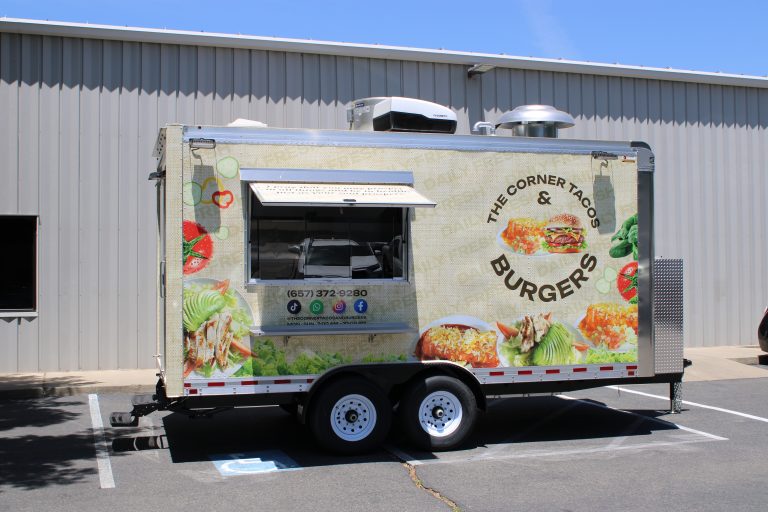
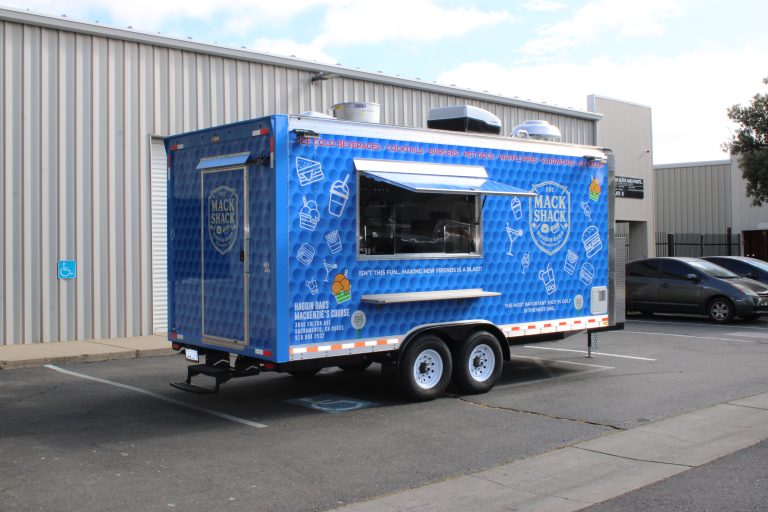
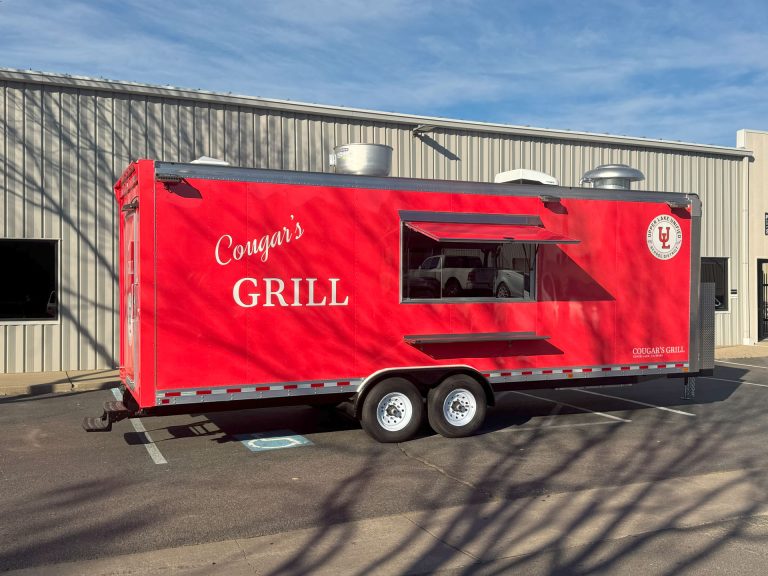
Our own crew fabricates your trailer in Olivehurst, CA, and the shop is open by appointment at every stage. When production wraps up, pick it up yourself or let us ship it to Fort Worth. Delivery covers all 50 states.
Once it reaches Fort Worth, the trailer goes to its DSHS pre-licensing inspection before the state license is issued. At that site, its sinks, refrigeration and wastewater system must run without electric or water hookups.






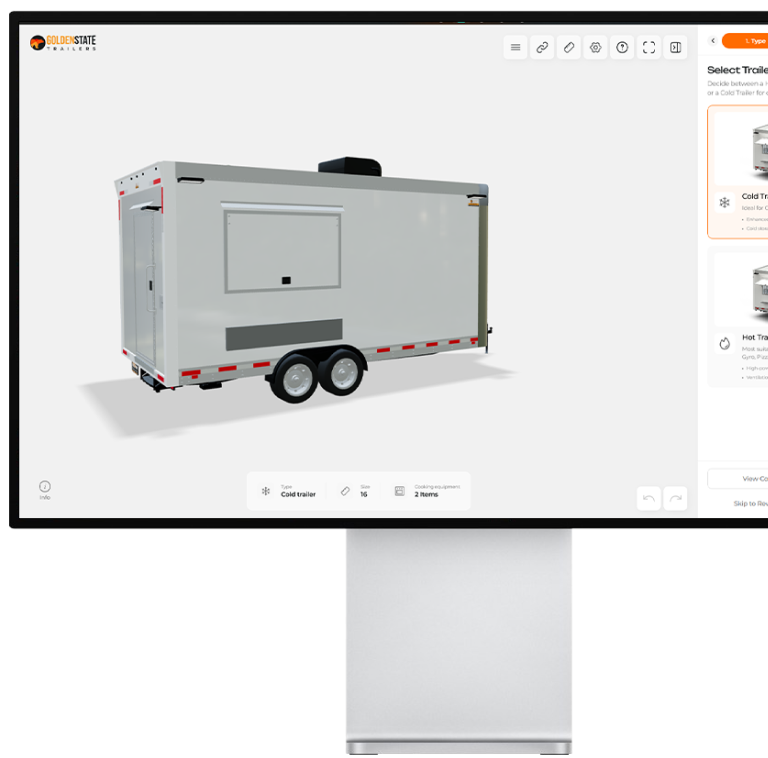
Using the 3D builder costs nothing. You create no account, and there is no cap on how many layouts you try. Pick hot or cold and a trailer length. Then add the kitchen line, the service side and extras like an awning or generator. Come back within 90 days to change the design or share it.
Size the water system around one DSHS rule. The permanently installed waste tank must exceed the fresh tank by 15%. More fresh water for long Stockyards market days calls for a larger gray tank to match.
Golden State Trailers’ own crew builds our food trailers for sale in Fort Worth in-house in Olivehurst, California. We deliver the finished kitchen to Fort Worth, for service anywhere from a Stockyards weekend market to a private lot.
Our food trailers for sale listing shows models you can adapt. Custom food trailers can also start from a blank floor plan. Eight lengths span 16 to 30 feet. The menu fixes the equipment list, which then fixes the floor plan and the utility loads.
A taco trailer working a griddle and fryer is a hot build, with a hood, gas lines and fire suppression. A coffee trailer is usually a cold build without them. Franchises, schools and corporate food service teams also order several matching units from us.
In the Fort Worth Stockyards, a cattle drive runs daily at 11:30 a.m. and 4 p.m. On Clinton Avenue, the Stockyards Farmers Market opens Saturdays and Sundays and adds a night market every third Saturday. Mobile food is part of its vendor mix.
The Fort Worth Stock Show & Rodeo runs from mid-January into early February. Each April, the MAIN ST. Fort Worth Arts Festival sets up food courts downtown. Mayfest follows in Trinity Park along the river around the start of May.
The City’s Office of Outdoor Events permits public-property events that sell food or drinks. The organizer holds that permit. Our festival food trailers show layouts planned for event service.
In Fort Worth, mobile food vendors hold a state license from DSHS, the Department of State Health Services. The city’s Consumer Health mobile food vendor page sends applicants to DSHS rather than to a city permit.
A trailer that cooks, holds and serves food on board is a DSHS Type III vendor. After processing the application, DSHS sends a letter so you can book the pre-licensing inspection. A new vendor opens only after passing it, and the license runs one year from that date.
The DSHS guide goes from application straight to that inspection, with no separate plan review step. Ask DSHS when to apply, so the license work runs alongside our build.
The trailer travels to the inspection site and has to run there on its own. Handwashing, warewashing, refrigeration and wastewater must all work with no electric or water hookup.
DSHS also looks for hot and cold water under pressure at every sink. It wants a handwashing sink and a three-compartment sink that fits the largest utensil. The permanently installed waste tank must be 15% larger than the potable tank.
On our standard build, fresh water runs 56 to 80 gallons and the gray tank is 93 gallons. That keeps it more than 15% above even the largest fresh tank. Refrigeration has to hold without shore power at that inspection, so plan its power source with the layout.
Fort Worth’s Development Services Department issues the Mobile Vendor Certificate of Occupancy. A food vendor needs one to stay at a single location for more than an hour. Each location needs its own certificate, while approved flea markets and city-sanctioned events are excluded.
The city’s mobile vendor packet asks for restroom access at the site. Its application calls for a sales and use tax permit, which comes from the Texas Comptroller. It also has vendors of temperature-controlled food move the unit off the property each day. Confirm current lot rules with Development Services before you commit to a site.
In Fort Worth, Fire Code compliance and fire permits belong to the Fire Department’s Bureau of Fire Prevention. It takes permit applications online. Confirm with the bureau which permits a propane trailer needs before you order.
Hot builds get the exhaust hood listed in our build standards, UL 710 compliant and conforming to NFPA 96. CFM calculations for the appliances under it set the hood’s airflow. A 14×14 make-up air system brings replacement air in.
A stainless cabinet holds the suppression system’s agent tank next to the gas shut-off valve. Propane capacity reaches 400,000 BTU. An automatic changeover regulator switches tanks, and every appliance has its own shut-off valve. Tanks ride in enclosed aluminum compartments.
National Weather Service normals put Dallas/Fort Worth highs in the mid-90s°F in July and August. About 20 days a year reach 100°F or more. Against that heat, each build carries enhanced insulation with reinforced interior backing and a roof-mounted air conditioner rated 15,000 BTU.
Winter brings about 29 days a year with a low at or below freezing. Before a hard freeze, empty or protect the lines and tanks of a trailer that is not in use.
Fabrication waits for your approval of the 3D render. It shows equipment placement, service windows and workflow, as our build process describes. Engineering blueprints follow, with electrical, plumbing and gas diagrams, and progress photos reach you during production.
Our pre-shipping tests cover brakes, structure, plumbing connections and electrical load. Hot builds add gas line pressure, hood airflow and fire suppression.
After delivery, we still answer questions on health department permits and inspections. Request a quote through the form, which takes your preferred size, timeline and budget. Our team then contacts you about the build.

At Golden State Trailers, we build custom commercial food trailers around real operational needs. Every project is planned with equipment, workflow, systems, safety, and long-term reliability in mind. Our goal is to build food trailers that perform reliably in daily commercial use.