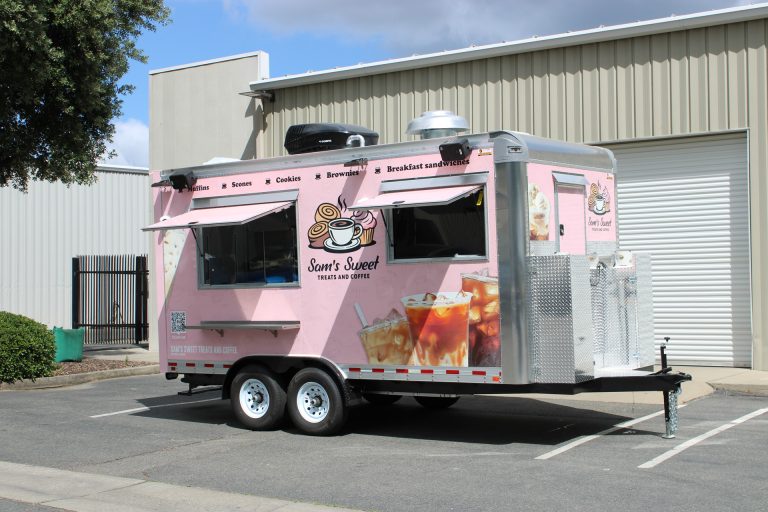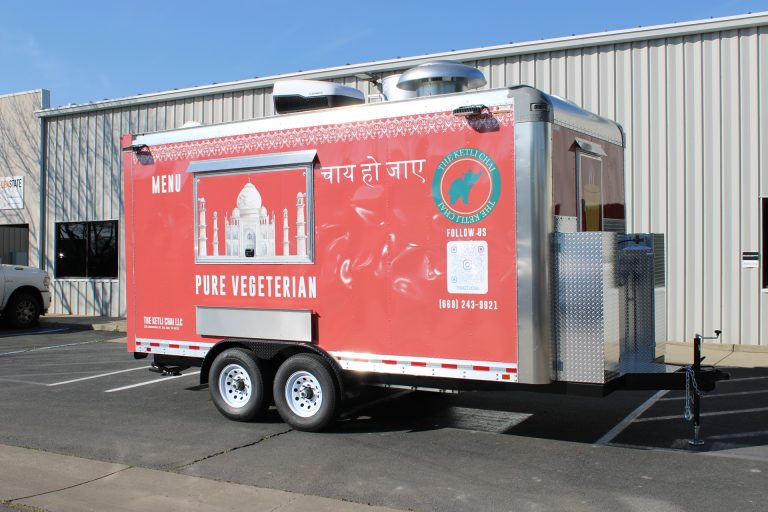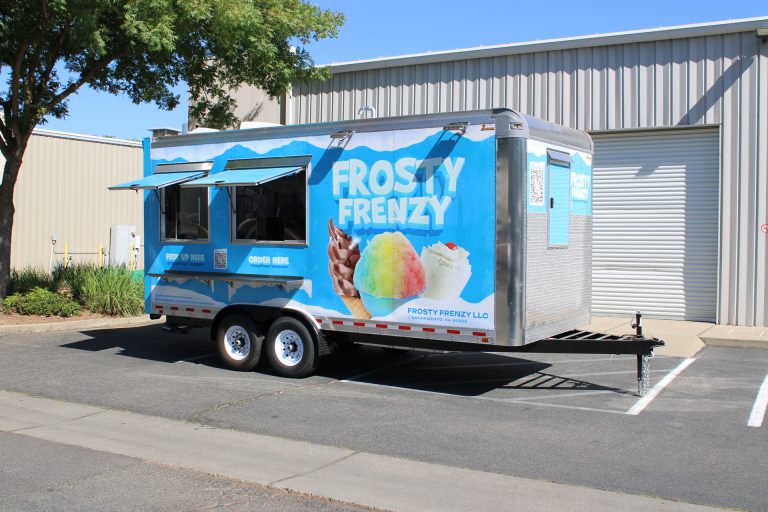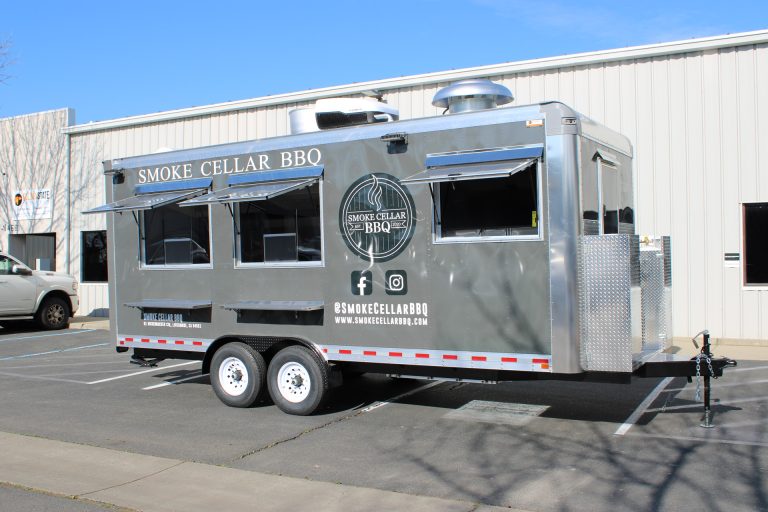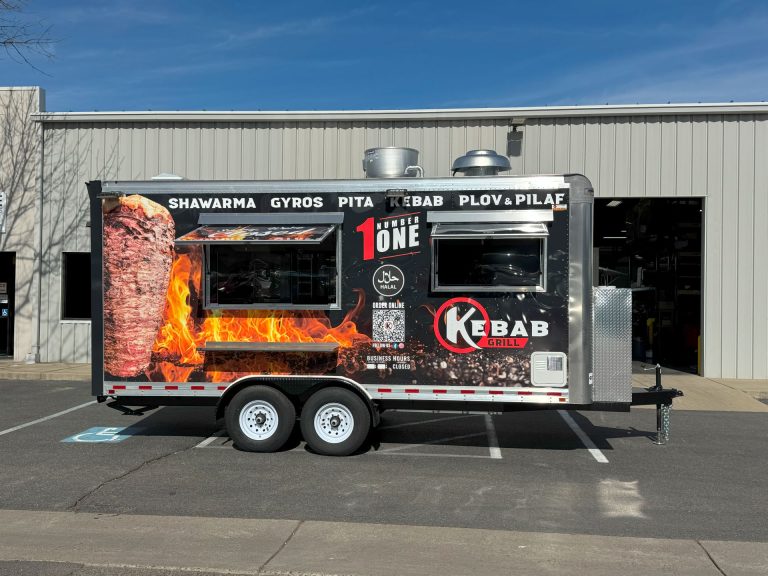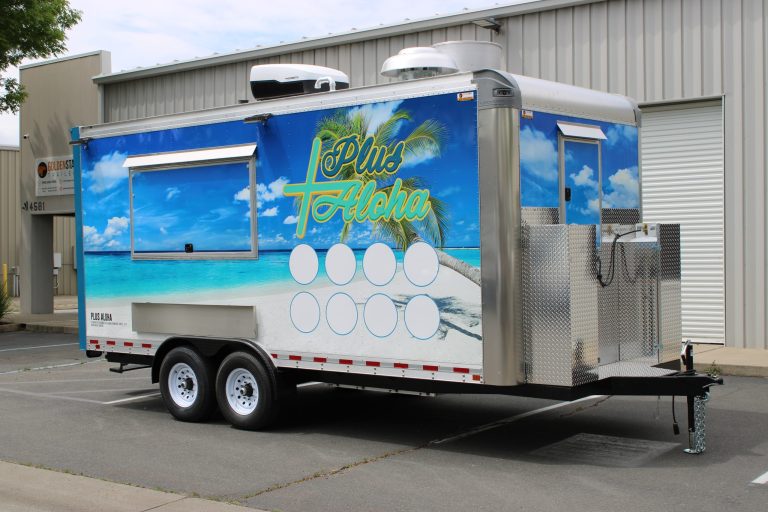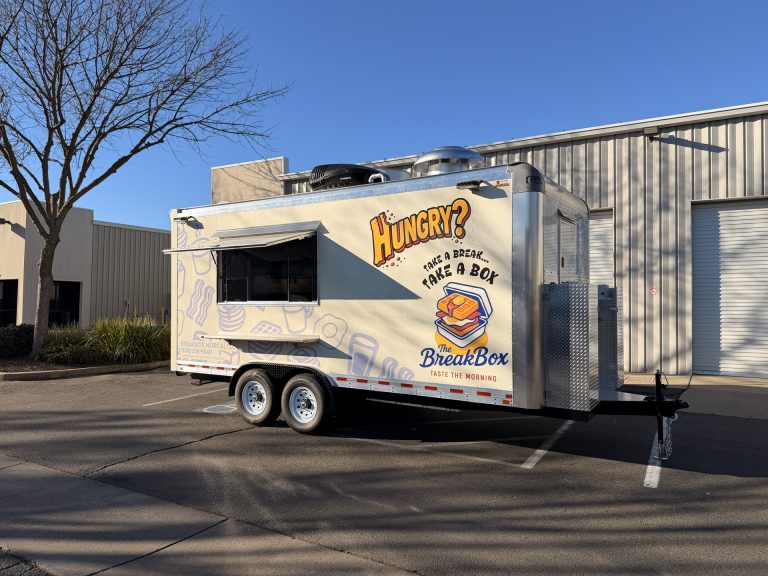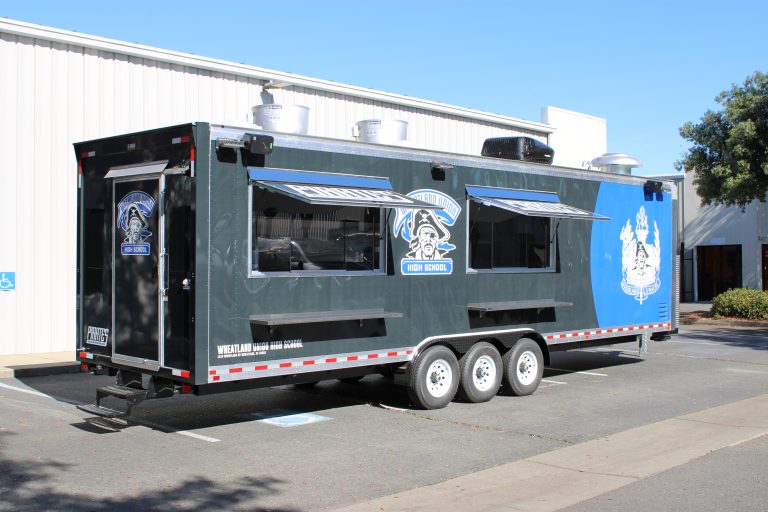


Our crew in Olivehurst, CA, fabricates your trailer from the frame up. You can visit by appointment while it is in production. When it is finished, it leaves Olivehurst with you or on a carrier bound for Oklahoma City. We deliver to all 50 states.
In Oklahoma County, the Oklahoma City-County Health Department (OCCHD) inspects and licenses a mobile food unit before it opens. A hot trailer whose cooking produces grease-laden vapors also needs the Oklahoma State Fire Marshal's inspection and decal.











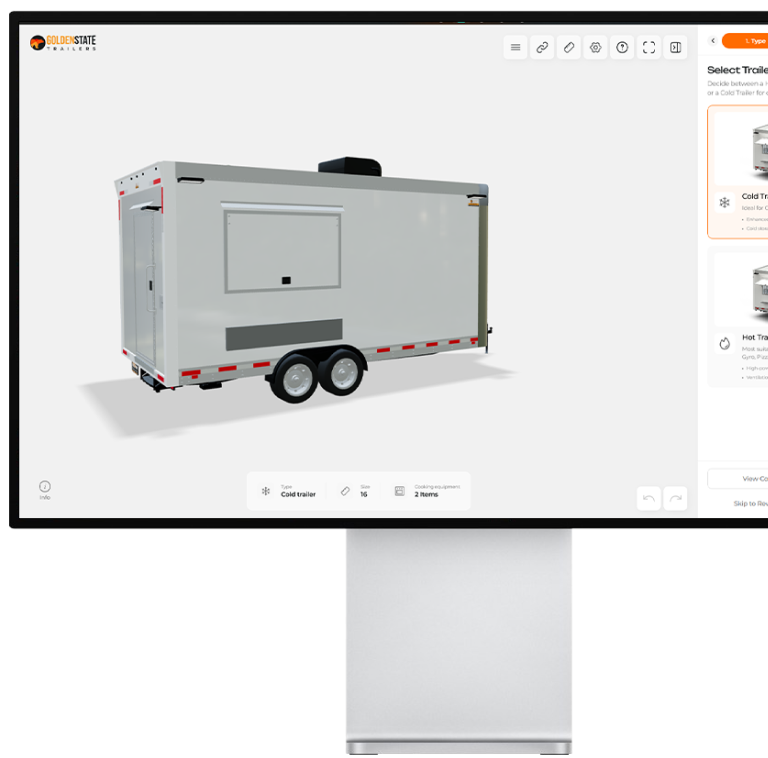
Our 3D builder is free and asks for no registration. Set the kitchen to hot or cold and choose one of eight lengths. Then fill the kitchen side with equipment and the service side with prep tables and handwash stations. Your layout keeps for 90 days, so a partner or chef can review it.
OCCHD's plan review form asks whether the water heater covers peak demand. Note your menu's hot-water needs in the builder's comments box. You can submit the plan the builder generates to OCCHD before production begins.
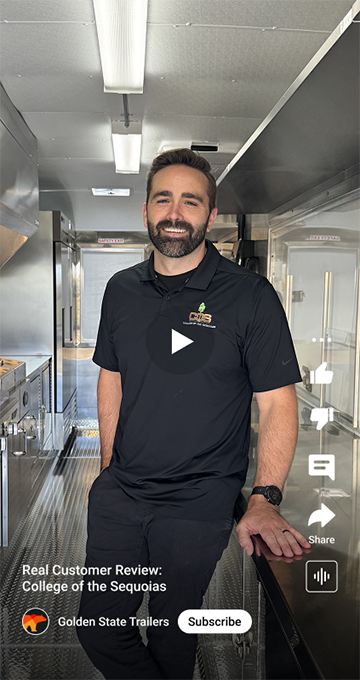
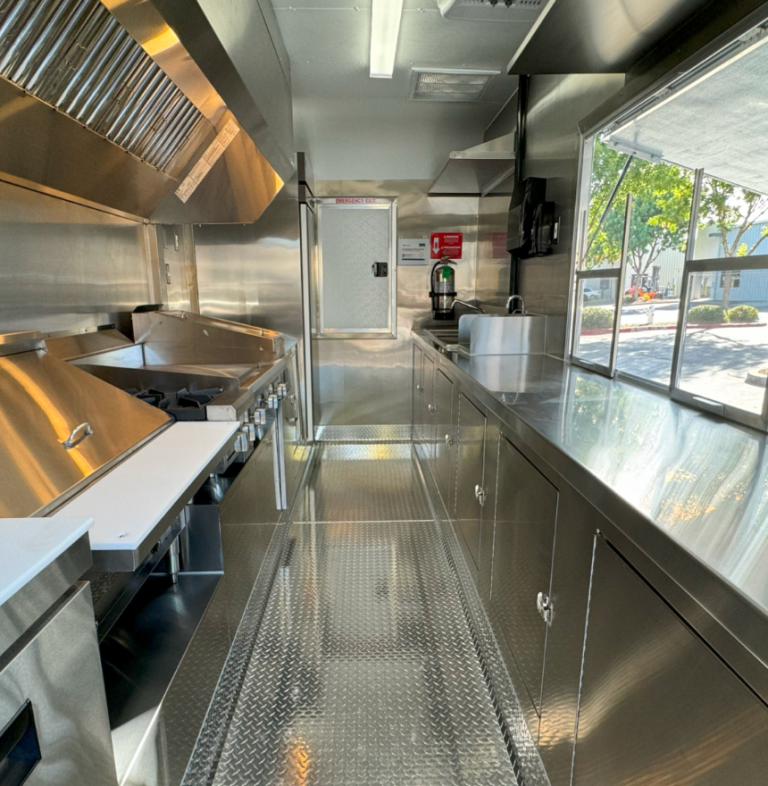
Each of the food trailers for sale in Oklahoma City from Golden State Trailers is a working commercial kitchen. Our own crew welds, wires and plumbs each one in Olivehurst, California, and a carrier brings it to your site.
Your menu sets the appliance list, and that list sets the layout, the power and water supply, and any propane. A pizza trailer is a hot build, so ventilation, gas lines and fire suppression come with it. A cold coffee trailer leans instead on sinks, water capacity and refrigeration.
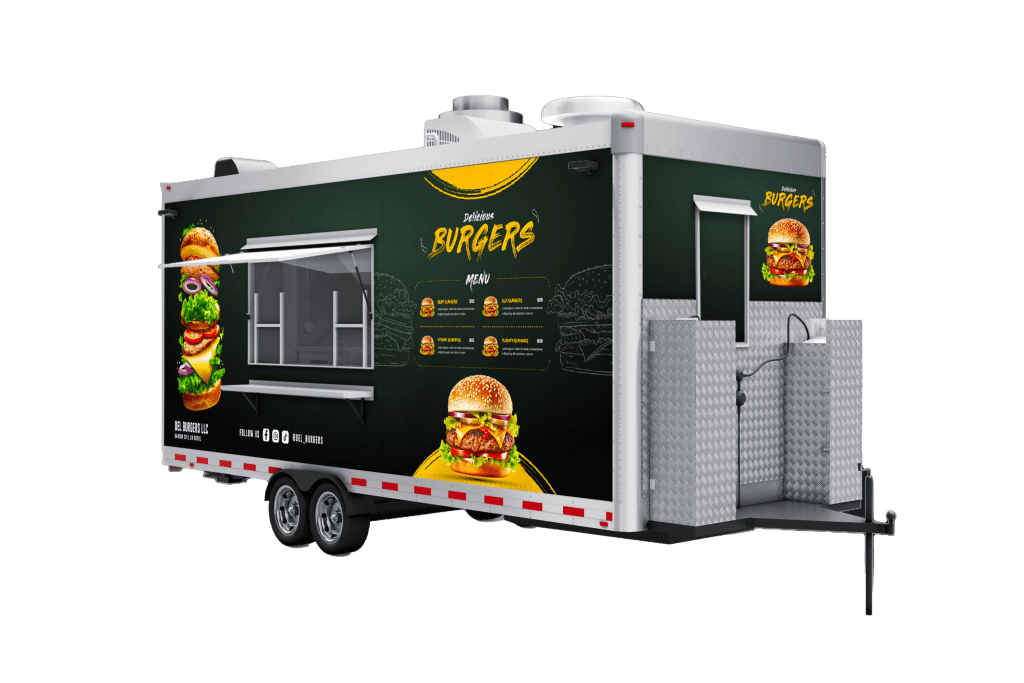
Our concession trailers and food trailers for sale show starting layouts across eight trailer sizes, 16 to 30 feet. Each custom food trailer is then drawn around your own equipment list. We also take on multi-unit projects for schools, franchises and corporate food service.
Scissortail Park hosts mobile food vendors on weekends, at events and during its markets. The lineup changes every Wednesday. The park’s Night Market runs along the Promenade each spring and fall, with vendors selling meals, snacks, drinks and desserts.
Each late April, the Festival of the Arts sets up an International Food Row in Bicentennial Park. Carts and mobile food units serve across the rest of the grounds.
Event organizers here send the Oklahoma City-County Health Department (OCCHD) their full vendor list 10 business days ahead. Check with the organizer that your trailer is on it.
State law lets a licensed vendor sell from private property in Oklahoma City once the owner agrees. Any zoning district open to food service establishments qualifies, with no required distance from restaurants or shops. A lot giving vendors parking and utilities on a continuing basis needs the city’s Vehicle Food Sales Court license.
For a trailer working in Oklahoma County, OCCHD issues the food establishment license under state law. That license counts as a state license, and OCCHD inspects each mobile unit before it may operate.
Oklahoma City adds its own Vehicle Food Sales license, issued by Development Services Business Licensing. A new application lists an Oklahoma Tax Commission sales tax permit and the OCCHD inspection among its steps.
OCCHD requires the plan review application, its fee and the trailer’s plans before any construction on the unit starts. Its current mobile plan review application lists a $425 fee.
A floor plan must place each plumbing fixture and piece of food equipment and show its water and waste connections. Spec sheets for every appliance go with it.
The form also asks for the service window size and the fresh and wastewater tank capacities. We fit a 93-gallon gray tank, with fresh capacity between 56 and 80 gallons.
The Oklahoma State Fire Marshal inspects every unit whose cooking produces smoke or grease-laden vapors and issues its decal. Units from out of state must meet the same state food unit requirements and fire and life safety code. Inside city limits, the Oklahoma City Fire Department adds a Mobile Food Unit permit, yearly or per event.
The State Fire Marshal’s guide lists UL 710 and NFPA 96 among accepted standards for cooking hoods. Each hot trailer we build carries a UL 710 compliant exhaust hood that also meets NFPA 96.
Fresh air returns through a 14×14 make-up air system. A stainless cabinet houses the suppression system’s agent tank, alongside the gas shut-off valve and a gas leak detector. Cold trailers for coffee or ice cream carry no hood, suppression or gas lines.
Every propane unit needs a permit and a yearly inspection from the Oklahoma Liquefied Petroleum Gas Administration. Before that inspection, a plumber the agency licenses documents a leak check and pressure test on its form.
The State Fire Marshal’s guide caps cooking propane carried on a unit at 200 pounds in total. It also calls for a listed gas alarm near the propane components. Our propane setup pairs 400,000 BTU of capacity with automatic changeover, individual appliance shut-offs and enclosed aluminum tank compartments.
July highs in Oklahoma City average about 93°F, and roughly 73 days each year hit at least 90°F. A hot line adds its own heat, so the cabin gets a 15,000 BTU roof air conditioner. The walls carry enhanced insulation and reinforced interior backing.
Freezing nights, 32°F or colder, number about 72 a year. On a trailer parked through a January freeze, drain the water lines and tanks or keep them protected.
May is the city’s wettest month. The crowned one-piece aluminum roof sheds runoff, and our riveted aluminum shell is made to resist water intrusion.
Fabrication ends in the shop with a full system test, step four of our build process. Before release, our crew checks the electrical load, the gas line pressure, every plumbing connection, the brakes and the frame. On hot trailers, the suppression system and hood airflow are tested too.
The handoff walkthrough covers the cooking line, gas and power, the water tanks and the suppression system. Store the handoff documents on board, from the blueprints and manuals to the warranty card, for each inspection.
When the menu and timeline are set, request a quote and describe your Oklahoma City trailer in the form.
At Golden State Trailers, we build custom commercial food trailers around real operational needs. Every project is planned with equipment, workflow, systems, safety, and long-term reliability in mind. Our goal is to build food trailers that perform reliably in daily commercial use.