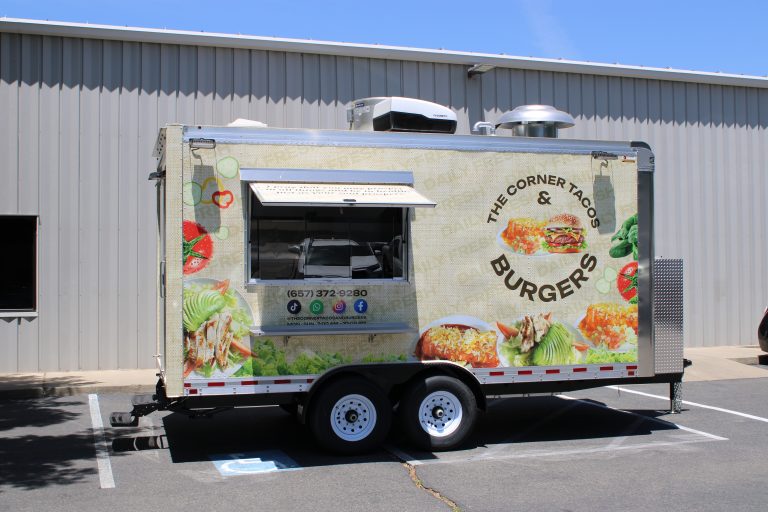
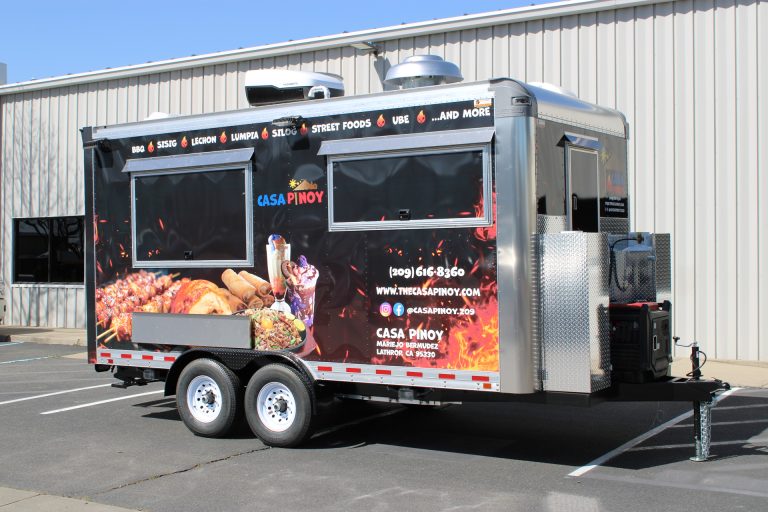
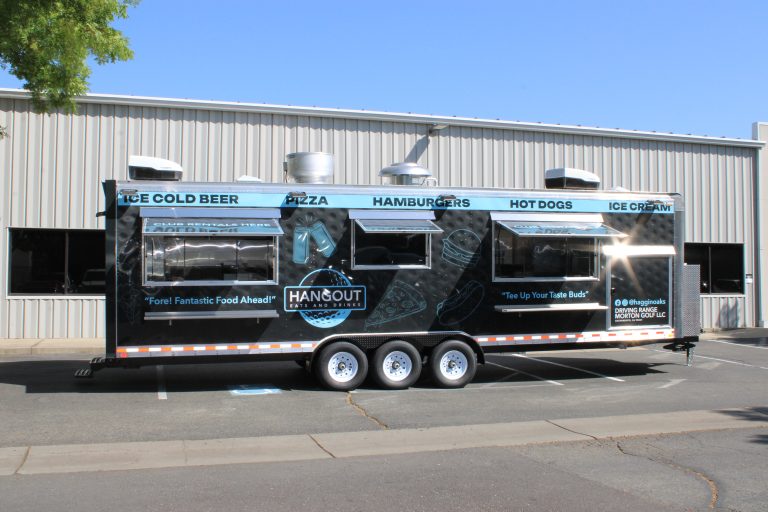
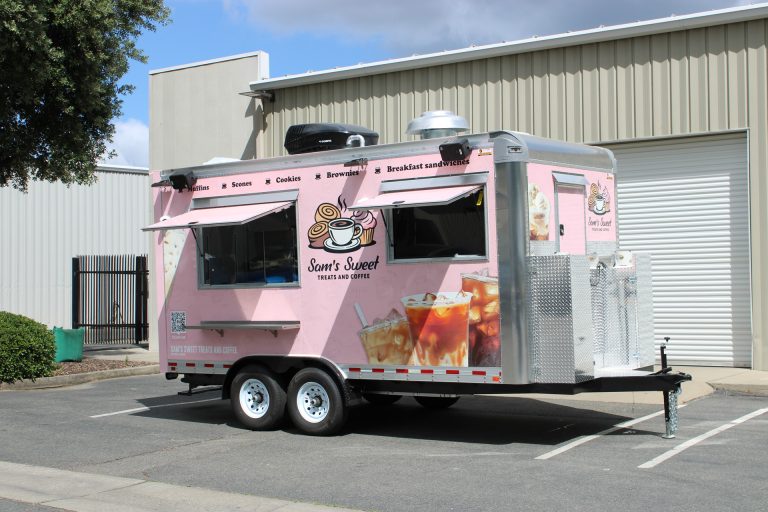
Your trailer is welded, wired and plumbed in our own facility in Olivehurst, CA. You are welcome to see it at any stage by appointment. When it is done, collect it from our shop or have a carrier bring it to San Antonio. We deliver to all 50 states.
After delivery, the state health agency, DSHS, schedules the pre-licensing inspection of your San Antonio trailer. If it cooks with propane or runs a generator, the San Antonio Fire Department inspection then follows once a year.







Designing in the 3D builder costs nothing and needs no account. First set hot or cold and the trailer length. Cooking, refrigeration and prep gear go on the kitchen side. Handwash stations and branding go on the side customers face. Your design stays saved for 90 days, and you can share it with a partner or chef.
Plan the interior around the San Antonio Fire Department's form: a 30-inch clear aisle and 74 inches of headroom. Past 10 feet of interior travel, the form also asks for a second exit, 24 by 24 inches or larger.
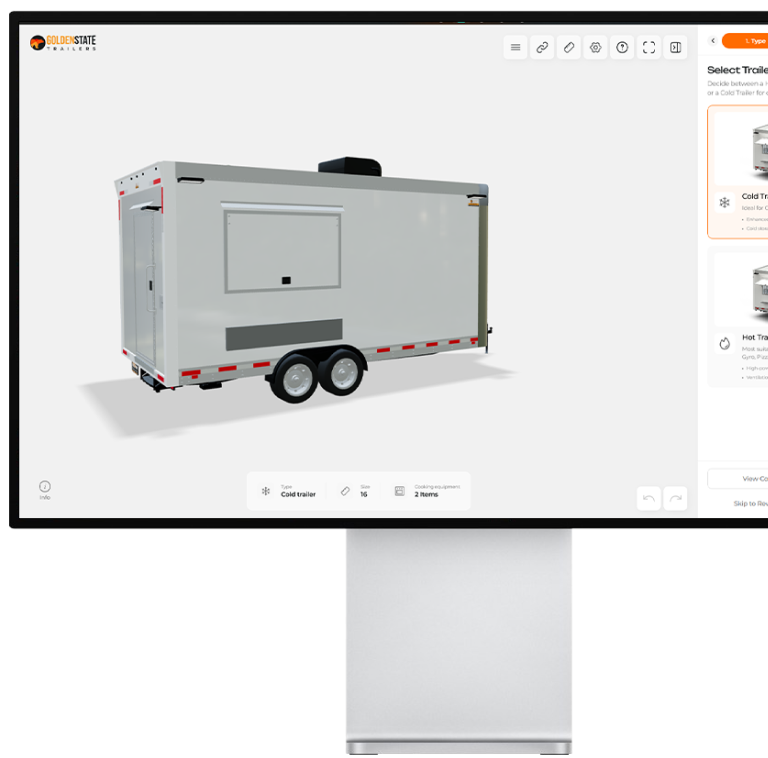
Our food trailers for sale in San Antonio are commercial kitchens on a towable steel chassis. Golden State Trailers builds them in Olivehurst, California, and ships each finished unit to your site in the city.
Pick a starting model from our food trailers for sale, or have us draw a custom food trailer. Your menu decides the equipment list. That list then fixes the power, water and propane the trailer must supply.
Fryer and griddle menus need a hot trailer, and coffee trailers or dessert menus run cold. We build eight sizes between 16 and 30 feet long. Alongside single trailers, we handle orders of several units for schools, franchise operators and corporate food service programs.
Fiesta San Antonio fills each April with official events that draw food vendors. The San Antonio Stock Show & Rodeo opens in February and accepts food vendors through its own application.
Downtown, the Central Business District needs a separate vending permit from the City’s Downtown Operations Department. Its application asks for your Texas sales and use tax permit and a current health license. It also takes a current fire inspection permit and an insurance certificate naming the City.
The city is also home to Joint Base San Antonio, the largest joint base in the Department of Defense. For base food service, see our military food trailers.
The City’s mobile food vending page lists these location limits. Vending in a City park takes permission from the Parks and Recreation Department. Vendors keep 300 feet from a school’s property line from an hour before classes until an hour after. Residential property is off limits for vending.
In San Antonio, the health license comes from the state. Metro Health’s page sends vendors to DSHS, Texas’s Department of State Health Services. Each license belongs to the operator and lasts a year from the inspection it follows.
Before issuing it, DSHS performs a pre-licensing inspection of the trailer. A vendor without a current Texas license starts selling once that inspection is complete, so ask DSHS when to apply.
The license type follows your menu. Units that prepare, cook, hold and serve food fall under Type III. Coffee, snow cones and other food prepared for immediate service can fall under Type II.
DSHS lists each type and its fees on its mobile food vendor licensing page. At handoff you also get engineering blueprints, manuals for each appliance and a warranty card. File them in the trailer next to your license.
Metro Health’s page adds a fire step to the state license. A unit running propane, a generator or a gas, charcoal or wood-burning grill needs a yearly fire inspection.
The San Antonio Fire Department (SAFD) also issues a Fire Mobile Vending Permit. It applies when food is cooked or heated in the unit, or when a generator runs with it. Registration goes through the City’s BuildSA portal.
SAFD inspects against its mobile food establishment inspection form. These items shape a trailer’s layout:
Confirm the current form with SAFD before you approve your layout.
Hot trailers get ventilation, fire suppression and gas lines, which a cold coffee or dessert trailer does without. Our build standards specify the exhaust hood as UL 710 compliant, conforming to NFPA 96. CFM calculations match its airflow to your cooking line.
Replacement air enters through the 14×14 make-up air unit, while UL-classified stainless baffle filters trap the grease. In a stainless cabinet, the suppression system keeps its agent tank beside a gas shut-off and a leak detector.
The 400,000 BTU propane system feeds each appliance through its own shut-off valve. An automatic changeover regulator switches between cylinders, which ride in enclosed aluminum compartments.
Summer here peaks with normal August highs of 96°F, before a fryer or griddle adds heat inside. To keep the crew and the refrigeration working, our spec lists a 15,000 BTU air conditioner on the roof.
Enhanced insulation over reinforced interior backing lines the walls. The crowned, one-piece aluminum roof sheds rain in May, the city’s wettest month.
Nothing is cut or welded until you sign off on the 3D render. The engineering blueprints drawn from it then guide the build, and our process shows every stage in order.
Every system is tested before the trailer leaves Olivehurst. The list covers brakes, structure, hood airflow and fire suppression, then gas pressure, plumbing and electrical load.
During the handoff, we walk your crew through the cooking equipment, gas and electrical, water tanks and fire suppression. Ready to price a San Antonio build? Request a quote, using the form’s notes box for your menu and the drop-downs for size and timing.

At Golden State Trailers, we build custom commercial food trailers around real operational needs. Every project is planned with equipment, workflow, systems, safety, and long-term reliability in mind. Our goal is to build food trailers that perform reliably in daily commercial use.