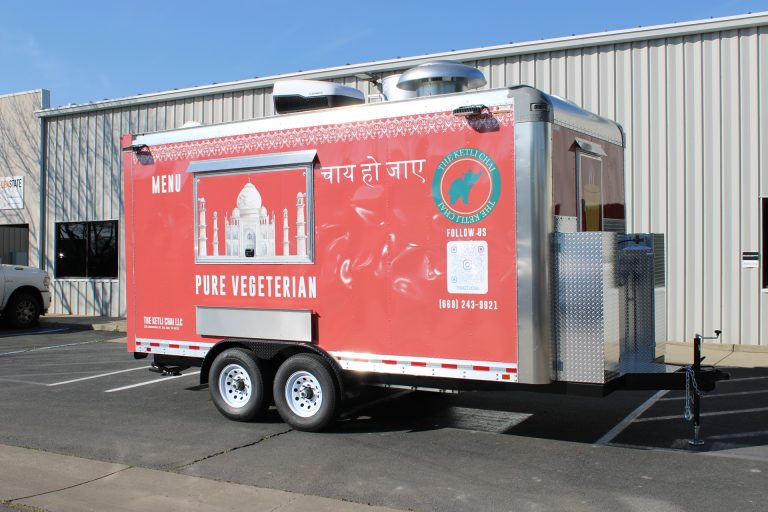
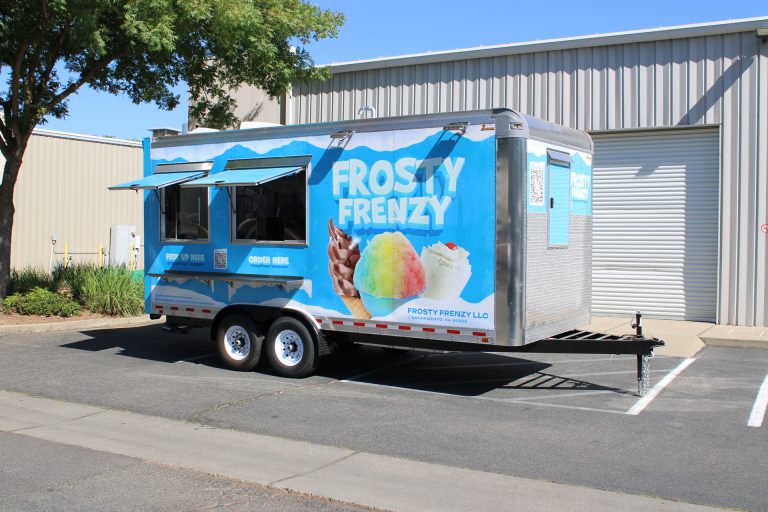
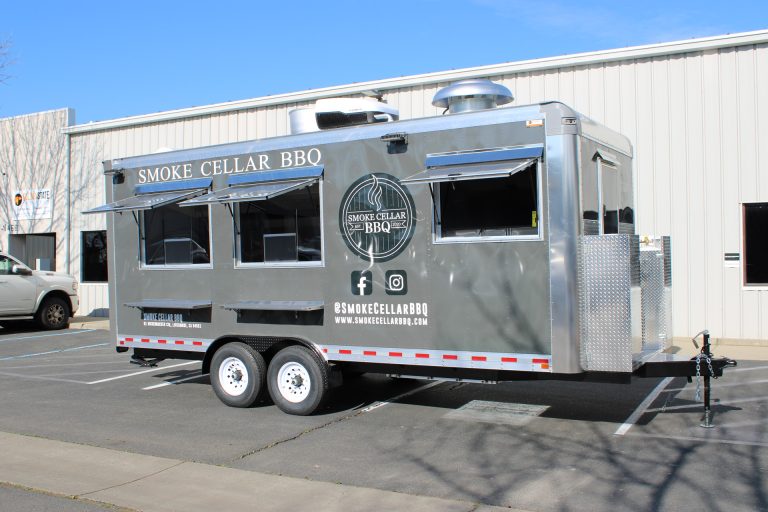
Every trailer comes together at our Olivehurst, CA shop, where you can visit by appointment during production. Once it is finished, pick it up there or have it delivered to Philadelphia; we deliver to all 50 states.
In Philadelphia, the City then inspects the unit at one of its public health offices, by appointment. Bring photo ID and proof that you own the trailer. Your food safety certified staff attend too, with their own ID.





Using our 3D builder is free, with no registration. Pick hot or cold, set one of eight lengths, then place the kitchen equipment; the required commercial sinks are already on the service side. Your design stays open for 90 days to revisit, change or share.
Plan for the City's refrigeration rule. Cold holding must be built into the trailer, reach 41°F or below and have an accurate thermometer. Outside coolers are not approved, so place every refrigerator and freezer in your layout before you submit the build.
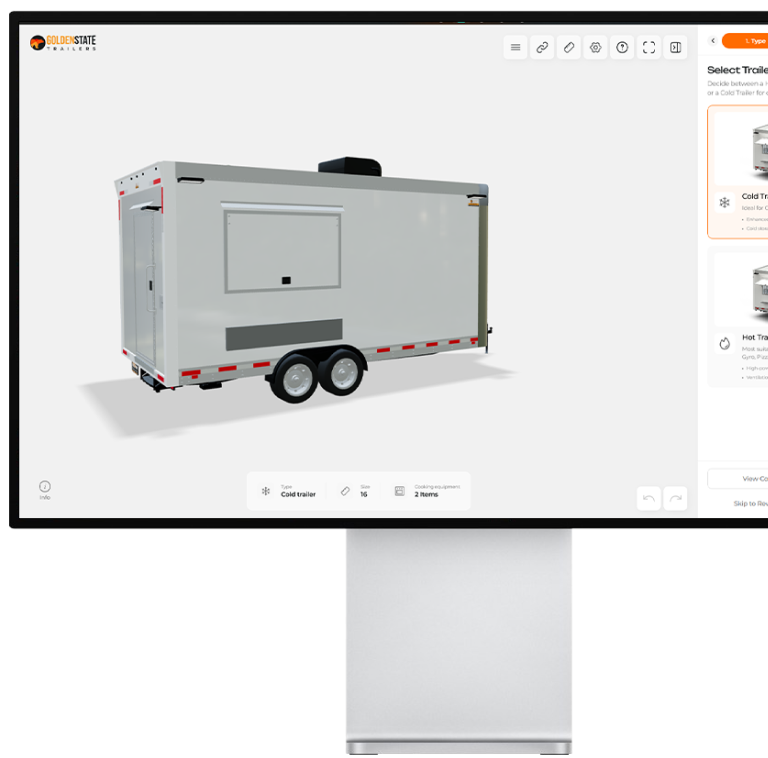
Every food trailer for sale in Philadelphia from Golden State Trailers is fabricated in our own shop in Olivehurst, California. No part of the build is outsourced, and each kitchen is engineered for the menu and daily workflow it carries. We then deliver the finished trailer to Philadelphia.
The menu decides the equipment, and the equipment decides the layout, power and water. A shawarma trailer cooks on a hot line, while a coffee or ice cream menu runs from a cold trailer.
For starting layouts, browse our food trailers for sale and custom food trailers. Our food trailer design and sizes overview lists every length from 16 to 30 feet side by side.
In Philadelphia, City departments license mobile food, not the Pennsylvania Department of Agriculture. The Department of Public Health’s Office of Food Protection counts towed trailers among mobile food vending units.
Every new mobile food business files a plan review with the Office of Food Protection. The City wants it approved before construction begins or food equipment goes in.
The application asks for an accurately scaled plan placing all food equipment, plus each appliance’s make, model and spec sheet. Our 3D render places every appliance, and our engineering blueprints add electrical and plumbing diagrams, plus gas on hot builds. We prepare the plan set and support you through the review.
After the City inspects the delivered unit, the Office of Food Protection issues a License Eligibility Report and an Operation Eligibility Certificate. With the report, you apply to L&I, the Department of Licenses and Inspections, for the Food Establishment Retail, Non-permanent Location License. It is renewed every year.
Confirm current requirements with both departments before you order.
The City’s mobile plan review form sets the water rules for every unit. The hand sink needs hot and cold running water under pressure, and the fresh tank must hold a full day’s supply.
The gray tank needs at least 15% more capacity than a day’s fresh water and ice. Expect 56 to 80 gallons of fresh water and a 93-gallon gray tank.
Washing utensils on board takes a three-compartment sink, separate from the hand sink. We install the sinks in the layout you approve.
The City’s plan review form ties installed equipment to federal, state and City codes for construction and fire safety. Ahead of festival season, the City’s Office of Special Events reminds vendors to keep compressed gas cylinders current.
Our hot trailers carry ventilation, fire suppression and gas lines, while cold trailers for non-cooking menus go without them. Per our build standards, the exhaust hood on a hot build is UL 710 compliant and follows NFPA 96. Make-up air arrives through a commercial-grade 14×14 system.
The fire suppression listed for our 20-foot trailer is a zone-protected UL 300 system. Gas runs through a 400,000 BTU propane system, and an automatic changeover regulator switches cylinders. Every appliance gets an individual shut-off valve.
Manayunk’s StrEAT Food Festival lines Main Street with mobile food vendors for a day each April. At City special events, you sell as a vendor named on the sponsor’s application, filed at least 30 days ahead.
The Health Department checks every food operator on event day, so keep your Operation Eligibility Certificate and food license on board. See our festival food trailers for event-focused layouts.
Philadelphia’s July highs average near 88°F, before a grill or fryer adds its share of heat. A 15,000 BTU rooftop air conditioner is included in our builds. That roof is one piece of aluminum, crowned to shed rain.
January lows average 26°F. Our walls get enhanced insulation with reinforced interior backing, listed as R13 for our 20-foot trailer. On freezing nights, drain or protect the water lines and tanks of an idle trailer.
Production follows the 3D design you approve, as our build process shows stage by stage. Before shipping, each system is checked: brakes, structure, plumbing connections, gas line pressure, electrical load, hood airflow and fire suppression.
The handoff includes a walkthrough of each system, from the panel and water tanks to the cooking equipment. You also receive the blueprints, the equipment manuals and your warranty card. Store them in the trailer next to your L&I license.
When your menu is settled, request a quote. The form takes your trailer size, timeline and notes on the equipment you need.

At Golden State Trailers, we build custom commercial food trailers around real operational needs. Every project is planned with equipment, workflow, systems, safety, and long-term reliability in mind. Our goal is to build food trailers that perform reliably in daily commercial use.