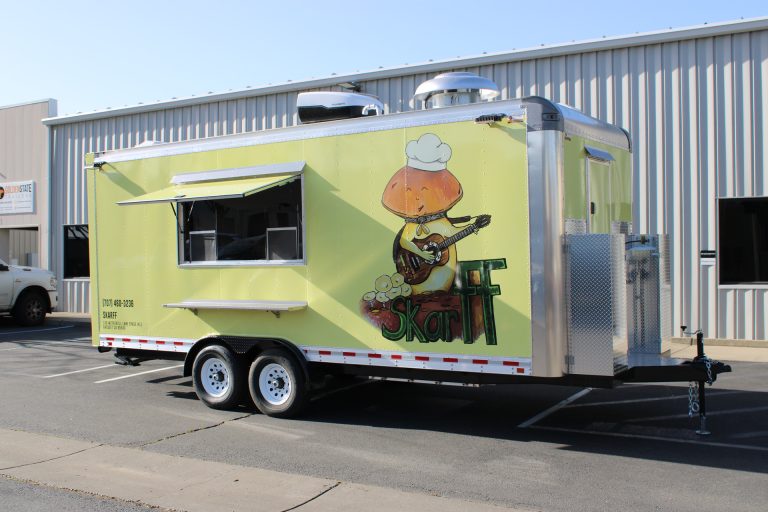
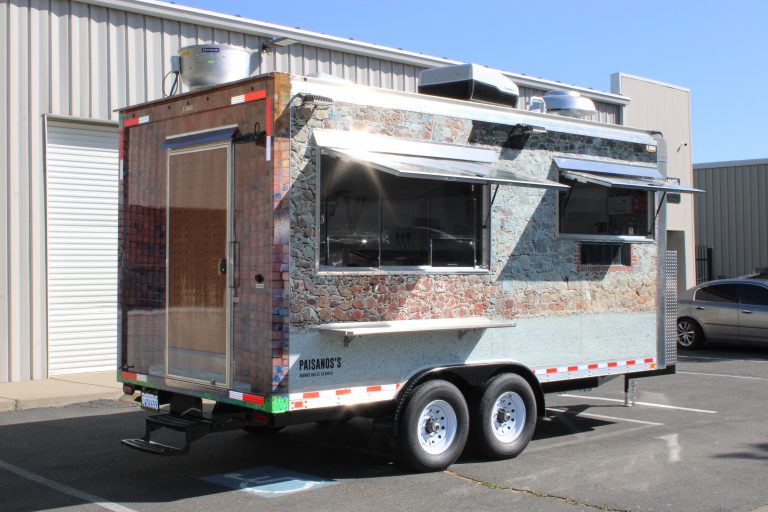
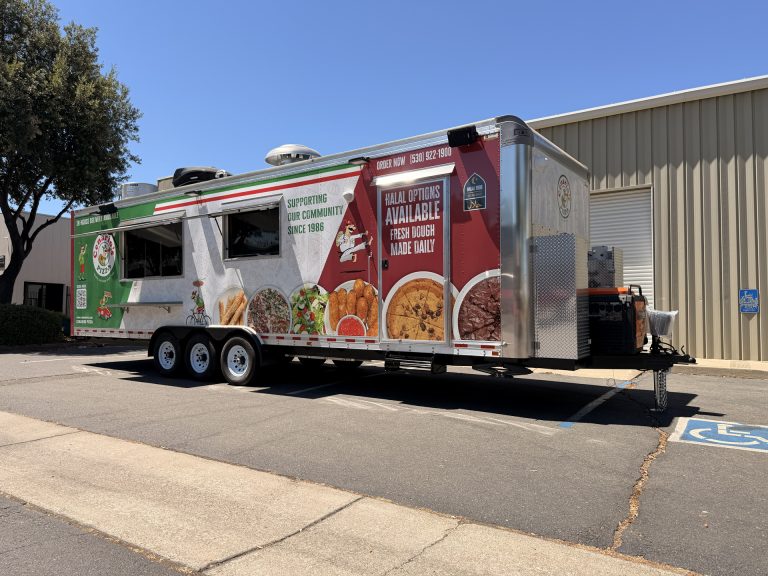
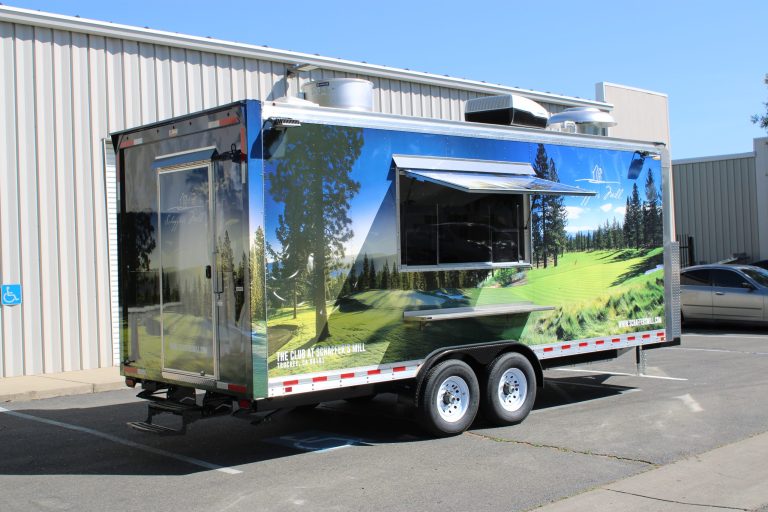
Our own crew welds the frame and fits every system at our Olivehurst, CA shop. Island buyers can visit by appointment at any stage of production. A finished trailer can be collected in person or shipped out to Oahu.
Once it arrives on Oahu, the Department of Health is the next stop. Its Food Safety Branch inspects the trailer and its support kitchen, and both must pass before you open. Line up that kitchen while the trailer is still in production.








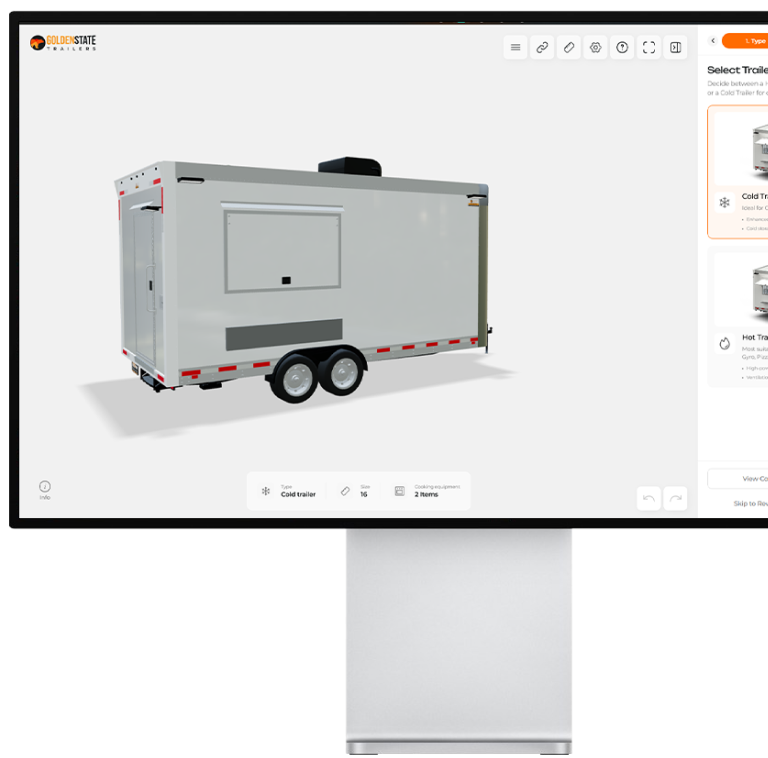
The 3D builder is free and needs no sign-up, so you can test layouts for your Oahu menu without limit. Choose hot or cold, set one of the eight lengths and place the kitchen and service equipment. Each saved design can be reopened, changed or shared for 90 days.
Design around DOH's rule that all equipment stays attached to the trailer, with food handled only inside. Put cooking, refrigeration and prep equipment on board rather than counting on gear set outside.
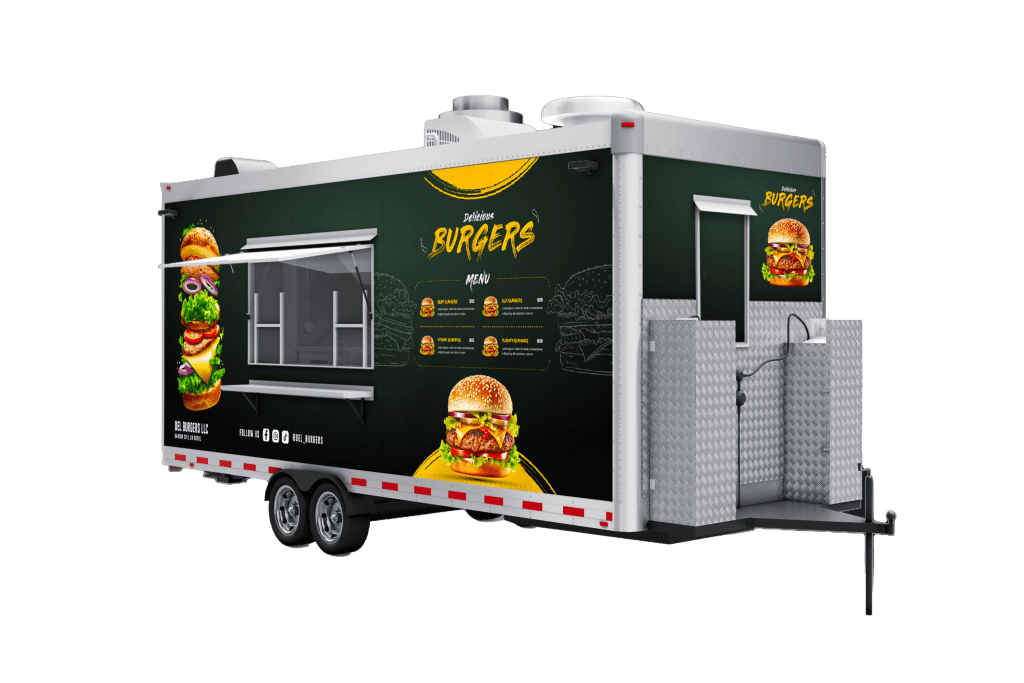
Food trailers for sale on Oahu come from our Golden State Trailers shop in Olivehurst, California. Our own crew builds each one, and it ships to the island fully equipped to the design you approved.
Planning starts with the menu, which sets the equipment, the layout and the water, power and propane loads. A Hawaiian food trailer serving plate lunches needs a hot line. A coffee trailer starts from its water supply.
Our food trailers for sale show layouts to start from. For a layout drawn from scratch around your menu, see custom food trailers. We also build mobile catering trailers, and multi-unit projects for schools, franchise brands and corporate food service.
The Hawaii State Department of Health (DOH) permits mobile food units statewide, Oahu included, through its Food Safety Branch. Its definition of a mobile food establishment names trailer-type vehicles alongside lunch wagons and push carts.
DOH reviews plans before a new unit is built or bought. Its guide to starting a mobile food establishment asks for drawings to scale, with top and side views.
Lock the menu before the drawings are finished, because the plans fix where each sink and appliance goes.
DOH requires most mobile units to work with an approved support kitchen. Any brick-and-mortar restaurant holding a current food establishment permit can serve as one, but a home kitchen cannot.
The inspector decides whether a kitchen can support your unit, judging your business plan, menu and its facilities. The trailer returns there as needed for cleaning and servicing.
For a trailer, that kitchen is where the tanks are filled and emptied and stock is loaded. Check that you can tow in, turn around and reach its drain point.
DOH wants all equipment attached to the unit and all food handled inside it. Tables and coolers set on the ground are not allowed, so counters and storage belong on board.
Water tank size follows the menu, and the wastewater tank must be more than 15% larger than the potable tank. On our builds, a 93-gallon gray tank sits alongside 56 to 80 gallons of fresh water.
Site power must disconnect quickly, since DOH allows no permanent hookup. Inside, a 24-circuit panel rated at 125 amps runs on 50-amp, 240-volt service.
Normal August highs at the Honolulu airport run near 89°F, and grills and fryers raise the cabin temperature further. Our standard roof air conditioner is rated 15,000 BTU for that heat. Enhanced insulation on reinforced interior backing comes with it.
Most of the airport’s yearly rain falls from November through March. That rain runs off a crowned roof made from one aluminum sheet. The riveted aluminum exterior skin is designed against water intrusion.
Lows stay well above freezing, so idle tanks need no winter draining.
On Oahu, fire safety falls under the City and County of Honolulu fire code. It adopts the State Fire Code, which is built on NFPA 1. That code calls for a witnessed acceptance test of a commercial cooking suppression system before its first cooking.
Confirm whether that test applies to your trailer with the Honolulu Fire Department’s Fire Prevention Bureau before you order.
HFD’s inspections page calls for automatic fire-extinguishing systems that meet UL 300 or an equivalent standard. On our 20 ft hot trailer spec, suppression is UL 300 and the hood is UL 710, to NFPA 96.
Each hot trailer also gets 14×14 make-up air and a 400,000 BTU propane system with automatic changeover. A cold trailer for coffee or shave ice skips the hood, suppression and propane.
DOH issues the food permit, while the City and County of Honolulu decides where units park and sell. Those rules apply island-wide, in Waipahu as in downtown Honolulu. Public places call for a city peddler’s license from the Business License Office and a state General Excise Tax license.
City code bars peddling on public places in Waikiki, in school zones during school hours and on Fort Street Mall. City parks and beaches require a city concession or permit. For a private lot, ask the Business License Office at (808) 768-9700 which license applies.
Inside a parade or street usage permit area, food may be sold as the permit holder allows. Honolulu City Lights has opened with a block party on Punchbowl Street and the Civic Grounds, food vendors included.
Weekly Farm Bureau markets at Kapiolani Community College, Kailua Town Center and Mililani High School include ready-to-eat food. The Hawaii State Farm Fair has been held on state farmland in Whitmore Village, near Wahiawa. At Ala Wai Small Boat Harbor, the state offers a five-year mobile food concession by sealed bid.
Before event day, walk the tow-in path, the ground and where your window will face.
See each stage in our build process. Nothing leaves the shop until we test its brakes, structure, plumbing, gas line pressure and electrical load. On hot builds, the hood airflow and fire suppression are tested too.
We deliver to all 50 states, Hawaii included. You get a full system walkthrough at handoff, with your warranty card, equipment manuals and blueprints. Once your Oahu menu is settled, request a quote and note it in the form’s project details box.

At Golden State Trailers, we build custom commercial food trailers around real operational needs. Every project is planned with equipment, workflow, systems, safety, and long-term reliability in mind. Our goal is to build food trailers that perform reliably in daily commercial use.